Six ears. One food box.
Enam telinga. Satu kotak makan.
A six-microphone recorder for the rainforest understorey, built from a Raspberry Pi, a ReSpeaker array and everyday parts.
Perekam enam mikrofon untuk lantai hutan hujan, dirakit dari Raspberry Pi, ReSpeaker array, dan barang sehari-hari.
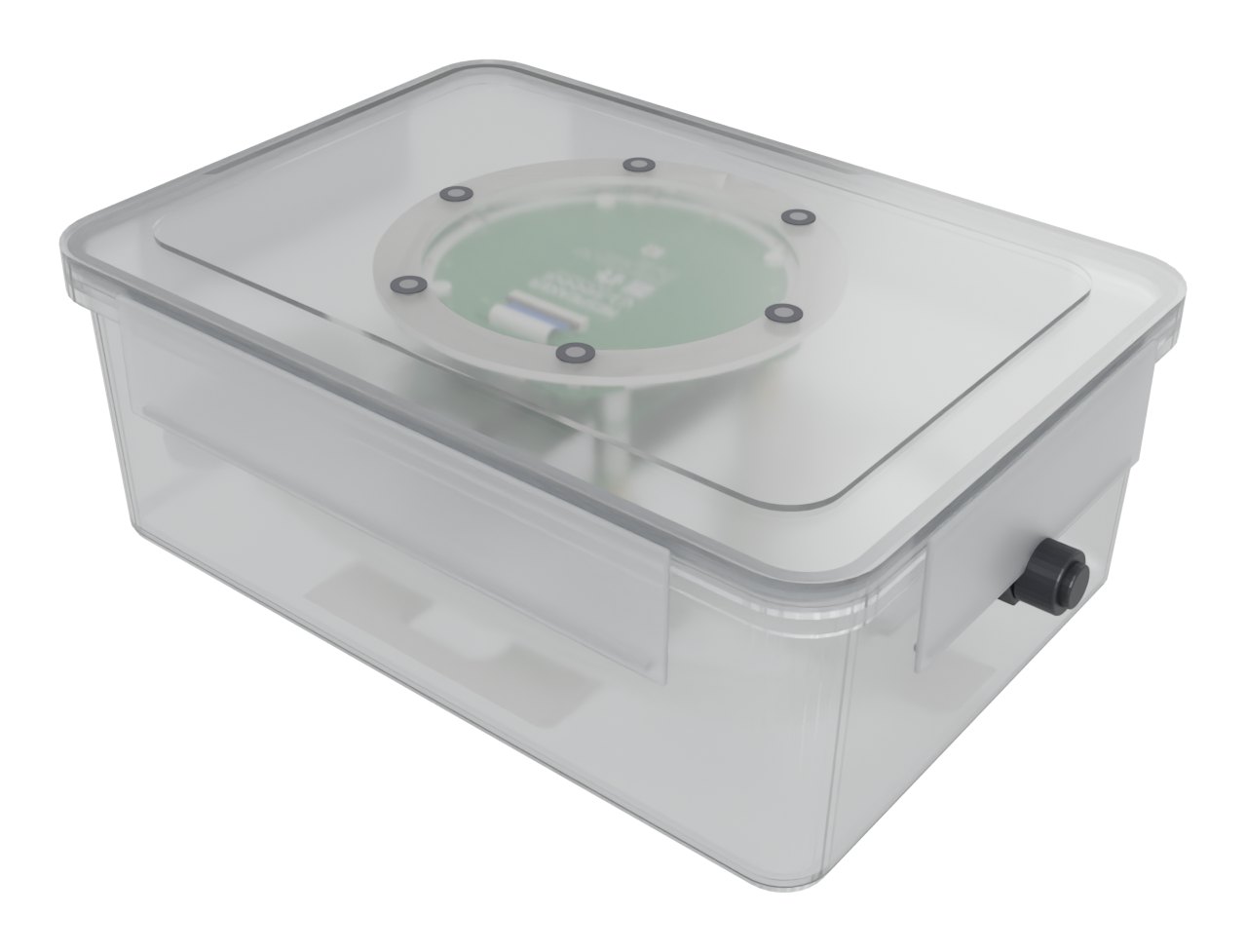
Small box. Serious listening.
Kotak kecil. Pendengaran serius.
Scroll to take it apart.
Scroll untuk membongkarnya.
Closed, it is just a food box.Tertutup, ia cuma kotak makan.
Six vents in the lid let sound in and keep rain out.Enam membran di tutup meloloskan suara dan menahan hujan.
A ring of six microphones sits right under them.Cincin enam mikrofon duduk tepat di bawahnya.
A voice HAT and a Raspberry Pi do the recording.Voice HAT dan Raspberry Pi yang merekam.
Brass legs on springs press it all against the lid.Kaki kuningan di atas pegas menekan semuanya ke tutup.
No sun. No signal. No problem.
Tanpa matahari. Tanpa sinyal. Tetap jalan.
Powerbank, not solar.
Powerbank, bukan panel surya.
The original MAARU runs on a solar panel and uploads over 4G. At Way Canguk, in Bukit Barisan Selatan National Park, the canopy is over 40 m tall and the forest has no mobile signal. So each unit runs on a powerbank in a dry bag and records to its microSD card.
MAARU asli memakai panel surya dan mengunggah lewat 4G. Di Way Canguk, Taman Nasional Bukit Barisan Selatan, kanopinya lebih dari 40 m dan hutannya tanpa sinyal seluler. Jadi setiap unit memakai powerbank dalam dry bag dan merekam ke kartu microSD.
A frame on springs.
Frame di atas pegas.
A 3D-printed frame holds the electronics on four springs. Clip the lid shut and it presses the mic array up against six small holes, each sealed with an adhesive vent that lets sound in and keeps water out.
Frame cetak 3D menahan elektronik di atas empat pegas. Saat tutup dikunci, mic array tertekan ke enam lubang kecil, masing-masing ditutup membran perekat yang meloloskan suara dan menahan air.
WiFi, added by hand.
WiFi, ditambah sendiri.
The Pi 2B has no WiFi, so a small USB adapter was added. It is not the toughest part, but it made fixes in the field possible and has kept working for more than six months. Data are uploaded in the village, then the unit goes back to the forest.
Pi 2B tidak punya WiFi, jadi ditambah adaptor USB kecil. Bukan bagian paling awet, tapi sangat membantu untuk perbaikan darurat di lapangan dan sudah bertahan lebih dari enam bulan. Data diunggah di desa, lalu unit kembali ke hutan.
Components & 3D
Komponen & 3D
Turn the model, pull it apart, and check the full parts list.
Putar modelnya, urai bagian-bagiannya, dan lihat daftar komponen lengkap.
ExploreJelajahiBuild
Merakit
Six assembly steps, the software setup, and the printable frame files.
Enam langkah perakitan, setup software, dan file frame yang bisa dicetak.
Start buildingMulai merakitResearch & contact
Riset & kontak
Our beamforming research, the MAARU papers, credits and contact.
Riset beamforming kami, paper MAARU, kredit, dan kontak.
Read moreSelengkapnyaMAARU was created by Becky Heath and colleagues at Imperial College London as a low-cost, open-source, six-channel recorder for spatial ecosystem monitoring. This site documents one adaptation of it. For the original design, the solar and 4G kit and the research behind it, visit the original MAARU site.
MAARU dibuat oleh Becky Heath dan rekan-rekan di Imperial College London sebagai perekam enam kanal yang murah dan open-source untuk pemantauan ekosistem secara spasial. Situs ini mendokumentasikan salah satu adaptasinya. Untuk desain asli, paket panel surya dan 4G, serta riset di baliknya, kunjungi situs MAARU asli.